LEVEL 2 (Form 1-3 Secondary School)
- Aug 12, 2016
- 11 min read
LESSON 1: UNICELLULAR ORGANISM
WHAT IS UNICELLULAR ORGANISMS?
Basically, is also known as single cell, whereas refer to the organisms that only consist of only one cell. It is very different from the because the multicellular organisms consist of more than one cell (which will be discusses in the next topic).
Historically, the simple single celled organisms have sometimes been referred to as (specially the unicellular flagellates). The main groups of unicellular organisms are bacteria, archaea, protozoa, unicellular algae and unicellular fungi. Unicellular organisms fall into two general categories: prokaryotic organisms and eukaryotic organisms (you can refer to topic Prokaryote Vs Eukaryote in level 3). Unicellular organisms are small which mostly invisible to our naked eyes.
Unicellular organisms are varies in sizes. The smallest organism a bacteria is only 300 nanometers and range up to 20cm. These organisms usually possess cilia, flagella or pseudopodia that help them in locomotion. They have simple body with basic features. Reproduction is both by asexual and sexual means. Nutrition is usually by the process of phagocytosis, where the food particle is engulfed and stored in vacuoles present in the organism. In this topic, we are going to discuss on several unicellular organisms and their structures and functions.
AMOEBA
An amoeba is a type of unicellular organism usually found in water around decaying vegetation, in wet soil and in animals such as humans. It is relatively advanced, and can extend and retract blob-like arms called pseudopodia, which it can use to grasp food particles and to propel itself through microscopic terrain. The name “amoeba” can mean a particular genus of microorganism or any member of a large family of similar life forms. Although most types are harmless, a few can cause serious diseases in humans. The majority are microscopic, but some species are large enough to be visible to the naked eye. Amoeba proteus is the best-known species, and it measures around 0.028 inches (0.7mm), which is just visible. Some species can reach 0.1 inch (about 3 millimeters) or more in diameter.
Here is the image of Amoeba sp.:

Source of image: Pixabay


Paramecium
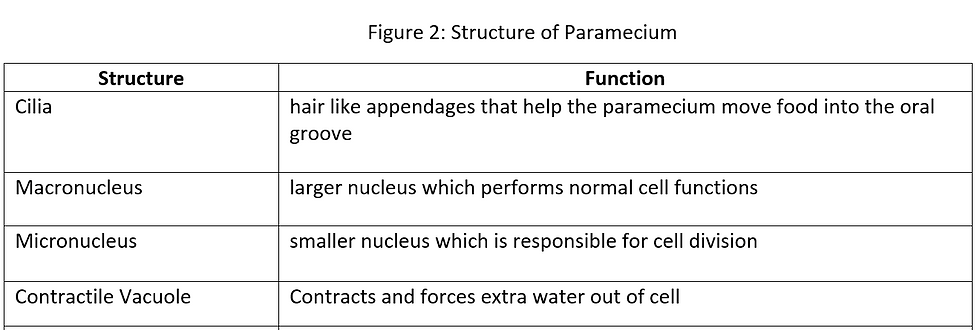
A paramecium is a unicellular organism belonging to the kingdom Protista, so it isn't exactly a plant or an animal. The organism can digest food, move through water by propelling itself with cilia, and reproduce. As one of the oldest organisms on earth, it has evolved and developed very simple methods of defense, genetic exchange, and mobility.
They use cilia to swim through water, and their one complex cell, a eukaryote, conducts all of the organism's basic functions. It doesn't divide labor between different tissues or cells like an animal. Instead, each paramecium is capable of an aerobic exchange, similar to breathing, reproducing asexually, ingesting nutrients, and expelling waste. Their size are very small, which is around 0.02 inches ( 0.5 mm long).
Here is the image of Paramecium sp. :

Source of image: Pixabay

EUGLENA
Euglena is in the kingdom of Protista, which have chloroplast and can make their own food through photosynthesis. Photosynthesis is the process by which plants, some bacteria and some protistans use the energy from sunlight to produce glucose from carbon dioxide and water. Oxygen is also formed during the process which will be release to the surrounding. They are not totally autotrophic, because it can also absorb food from the environment. Euglena is usually found in the ponds or even in the puddles.
Below is the image of Euglena sp.:

Source of image: Farhana bajunid, UPM


LESSON 2: MULTICELLULAR ORGANISMS
WHAT IS MULTICELLULAR ORGANISMS?
Multicellular organisms are organisms which are made up of more than one cell, in contrast with unicellular organisms. In other words, this cell will attach to each other in order to form multicellular organisms. Most of the multicellular organisms are visible to our naked eyes, which are for example, animals, land plants, most fungi and most algae.
Figure 1: Example of cells that made up multicellular organisms

Source of image: biology.tutorvista.com/cell/unicellular-and-multicellular-organisms.html
Multicellular organisms can be differentiate into two groups such that of multicellular prokaryotes and multicellular eukaryotes. In the group of multicellular prokaryotes, the examples include the multicellular bacteria species such as myxobacteria. Some algae are also multicellular such as cyanobacteria like Chara and Spirogyra. As for fungi, all types of fungi are multicellular except for yeast. In the group of multicellular eukaryotes, most of the eukaryotic organisms are multicellular. This is because these organisms are well-developed body structure and they have specific organ to perform specific functions.
CELL TYPES AND THEIR FUNCTION
ANIMAL CELLS
Figure 2: Animal cell

Source of image: http://www.buzzle.com/articles/plant-cell-structure-and-function.html
Table 1: Cell types and functions


Source: http://www.bbc.co.uk/education/guides/z46cwmn/revision/1
PLANT CELLS
Figure 3: Plant cells

Source of image: http://www.buzzle.com/articles/plant-cell-structure-and-function.html
STRUCTURE AND FUNCTIONS OF PLANT AND ANIMAL CELLS
Table 2: Structures and functions of animal and plant cells


Source: http://waynesword.palomar.edu/lmexer1a.htm
LESSON 3: Asexual and Sexual Reproduction
Asexual reproduction is the production of organisms from single parent, whereas sexual reproduction is the production of organisms from the fusion of two special cells which are gametes, we called them male and female gametes.
for more information on the steps of sexual reproduction, can refer to:
Example of asexual reproduction:
Budding
Budding is a common process in plants and fungi. It also occurs in certain animals, particularly the Hydra (sponges). In sponges, the outgrowth (bud) stays attached permanently while in fungi the bud stays for a while, and then detaches to grow fully as a new individual. Budding is a form of asexual reproduction since the process results in the formation of new individual but is a clone of the primary organism. In viruses, budding is their means to leave the cell while not causing lysis to their host cell. In this way, the remaining viruses can still propagate within the host cell.

Source of image: Farhana Bajunid, UPM
Budding Steps: refer to http://www.wikihow.com/Do-Budding-in-Plants
Binary fission
It is the most common form of reproduction in prokaryotes and occurs in some single-celled eukaryotes. After replicating its genetic material, the cell divides into into two nearly equal sized daughter cells. The genetic material is also equally split.
Steps:
Firstly, the chromosome replication begins, one copy of the origin moves rapidly to the other end of the cells.
Then the cells will elongate.
After the replication finishes, the plasma membrane grows inward and a new cell wall is formed.
Thus, it will result in the forming of two daughter cells.

Source of image: Farhana Bajunid, UPM
Spore Formation
Spores are formed by fungi and are often contained within a structure known as sporangium which will disintegrate releasing the spores into the environment. When a spore lands in a suitable environment it will germinate forming a new fungus. Spores are formed by budding.

Source of image: Farhana Bajunid, UPM
For Sporulation steps: refer to https://prezi.com/mfacy60pxb04/what-are-the-steps-of-spore-formation/
Vegetative Reproduction
Also known as vegetative propagation, it uses several of the plant parts for reproducing the plant asexually.
Basically there are various vegetative parts:
A. Vegetative propagation by roots:
The roots of some plants develop adventitious buds on them, examples on Guava, Dahlia, Sweet potato, etc. Some tuberous adventitious roots besides possessing adventitious buds also contain sufficient quantities of food, example Dahlia and Sweet potato.
B. Vegetative propagation by stems:
Straggling and branched rhizomes reproduce by vegetative reproduction, example like Banana, Ginger, Onion and Turmeric. The decay of older parts isolates the newly formed branches.
i. Stem tuber:
It is usually found in the Artichoke and also Potato. Potato, for an example, the tuber is a swollen apical part of an underground stem branch and bears a number of nodes or eyes. The new plants are produced from the buds on the eyes. Each of the eyes bears one or more buds. Thus, the Potato crop is raised by tubers and not by seeds.
ii. Runner:
It is usually for aerial weak stem, such as lawn grass, Mint and Wood sorrel. When their stem touches the ground, it will produce adventitious roots at nodes. Thus, when the older parts of plant die, the branches separate from the parent plant and form independent plants.
C. Vegetative propagation by leaf:
Some plants produce adventitious buds on the leaves such as Bryophyllum, Begonia, Streptocarpus, Kalanchoe and Saintpaulia. For an example, in Bryophyllum, the adventitious buds were notched on margins of succulent leaves. These buds are usually dormant, once the leaf is attached with the plants. However, the leaves when in contact with moist soil develop new plantlets along the margins.
Fragmentation hyphae
Fragmentation or clonal fragmentation in multicellular or colonial organisms is a form of asexual reproduction or cloning in which an organism is split into fragments. Each of these fragments developed into mature, fully grown individuals that are clones of the original organism. The major groups that produce by this type of reproduction is fungi. Fungi that make hyphae can reproduce asexually as well. Bits of the hyphae can break off and continue to grow as separate entities, or can form stalks containing seed-like spores. Although less common, fungi can produce spores sexually.

Source of image: Farhana Bajunid, UPM
Extra on fungi:
New colonies of fungi can grow from the fragmentation of hyphae.
During budding, a bulge forms on the side of the cell; the bud ultimately detaches after the nucleus divides mitotically.
Asexual spores are genetically identical to the parent and may be released either outside or within a special reproductive sac called a sporangium.
Adverse environmental conditions often cause sexual reproduction in fungi.
Mycelium can either be homothallic or heterothallic when reproducing sexually.
Fungal sexual reproduction includes the following three stages: plasmogamy, karyogamy, and gametangi
Sexual fungal reproduction
Sexual reproduction introduces genetic variation into a population of fungi. In fungi, sexual reproduction often occurs in response to adverse environmental conditions. Two mating types are produced. When both mating types are present in the same mycelium, it is called homothallic, or self-fertile. Heterothallic mycelia require two different, but compatible, mycelia to reproduce sexually.
Although there are many variations in fungal sexual reproduction, all include the following three stages. First, during plasmogamy (literally, "marriage or union of cytoplasm"), two haploid cells fuse, leading to a dikaryotic stage where two haploid nuclei coexist in a single cell. During karyogamy ("nuclear marriage"), the haploid nuclei fuse to form a diploid zygote nucleus.
Finally, meiosis takes place in the gametangia (singular, gametangium) organs, in which gametes of different mating types are generated. At this stage, spores are disseminated into the environment.

Source of image: Farhana Bajunid, UPM
So, what is the effect to sexual gametes & offspring having meiosis process?
Basically, meiosis that takes place during the sexual reproduction process is help in the production of the sperms and also the eggs cell of the parents. Besides that, the genetic variation also occurs because of its meiosis process that occur during the sexual reproduction.
For more information, can search at: http://sciencelearn.org.nz/Contexts/Uniquely-Me/Science-Ideas-and-Concepts/Meiosis-inheritance-and-variation
If you are curious on the meiosis process, you can search at: http://moodleshare.org/mod/book/view.php?id=2124&chapterid=273
Did asexual have meiosis? If no, what’s the effect to offspring?
Meiosis did not occur during asexual reproduction. Basically, the mitosis process will occur, which will produce an identical offspring. Mitosis is define as a process of asexual reproduction in which the cell divides in two producing a replica, with an equal number of chromosomes in each resulting diploid cell.
Asexual VS Sexual Reproduction


LESSON 4: Ecology

Source of image: http://media.tumblr.com/tumblr_m8xjyif5Do1qgfyua.gif
What is ecology?
Ecology is defining as an interdisciplinary study of how organisms interact:
With other organisms
With the environment
It is actually the about the interdependencies between biotic (living thing) and abiotic (non-living thing) components of the earth.
In this chapter, we are going to discuss on the ecological hierarchy. It is consist of 6 levels in the ecological hierarchy, which are organism, population, community, ecosystem, biome and biosphere.

Source of image: http://eschooltoday.com/ecosystems/images/Levels-of-Organization-in-an-Ecosystem.jpg

Source of image: http://www.mstworkbooks.co.za/natural-sciences/gr8/images/gr8ll02-gd-0001.png
What is an organism?
An organism is usually the basic unit in ecological studies. The type of organism is referred to as the species. Species is a group of organisms consisting of similar individuals capable of exchanging genes or interbreeding. For example like species of insects, bird, dog and etc.

Source of image: Pixabay
It is often define as the largest group of organisms in which two individuals are capable of reproducing fertile offspring, typically using sexual reproduction. So, they survived by depending on the abiotic factor (food, shelter, etc.) but some of them also survive by depending on other organisms.
What is a population?
A population is a group of organisms which are of the same species. The populations are geographically based, because they live in a particular area, thus they inhabiting the same geographical area and time. The organisms are regularly interacted with one another in order to survive. So, in the population the organisms are competing with each other for food, shelter, mate and etc. Such an example, we can talk about the human population in a city, population of
frogs in the ponds and the population of the coconut trees on one island.
Figure below: human population on earth

Source of image: Pixabay
What is community?

Source of image: http://www.ecologyedu.com/ecology_education_resources/ecology_primer/community_ecology_files/stacks_image_191.png
Community can be define as two or more different populations which inhabiting the same geographical area and time. Basically, they survive by depending on other organisms as food. We might be talking about the community of all the organisms living in the very top or canopy of a single rainforest tree or of all the trees in the forest. What’s most important about the community concept is that it involves multiple populations of all the different species in the given area and how these species interact with each other. Each of the populations is made up of individuals of a particular species, and the individuals interact with each other – with members of their own species (e.g., fighting, grooming, mating, pollinating each other) and with individuals of other species
What is ecosystem?

Source of image: http://5thgradecedarfork.weebly.com/uploads/8/2/1/5/8215136/5132547_orig.jpg
Ecosystem is all about the community (biotic factors) and the non-living components of its environment (abiotic factors). For example, temperature and rainfall patterns influence where different terrestrial species of plants and animals live; some can survive dry desert conditions, others need the high rainfall found in rainforests. But the forests themselves also influence temperature and rainfall patterns.
LESSON 5: Food Chain VS Food Web
WHAT IS FOOD CHAIN?
A food chain is a series of steps in which organisms transfer energy by eating and being eaten by other organisms. Food chains are varying in length, which will depend on the number of the producers and the consumers.
WHAT IS FOOD WEB?
A food web is actually contained of several food chains within a single food web. Most ecosystems have more complicated relationships when it comes to producers and consumers and can’t be described using a food chain. For an example, the eagles are not only ate mice, but it also can eat snakes at the same time. Food webs that contain food chain is the path from the producers to the final consumers.
Producers
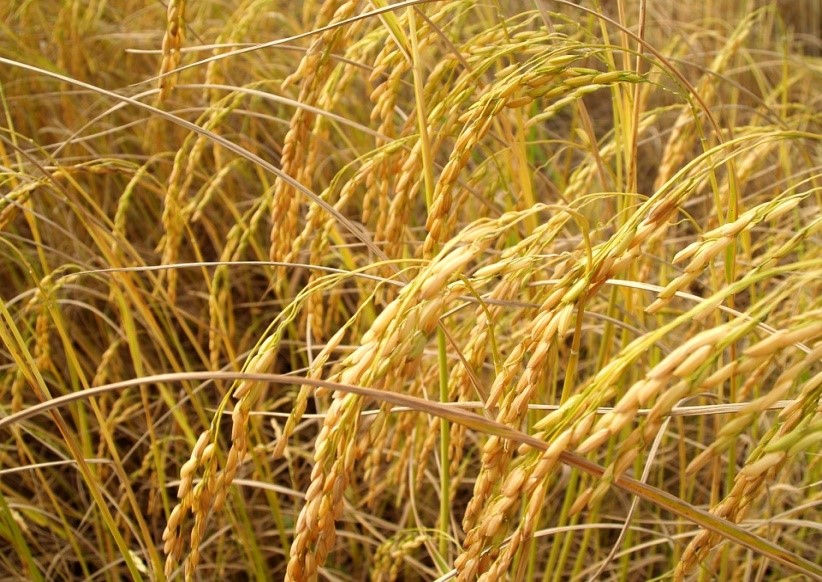
All plants are producers. This is because they are able to produce their own food without depending on other organisms or species. They are also known as autotrophs, which they make their own food by trap the energy from sunlight, which will undergo photosynthesis process.The product of the photosynthesis is that the energy will be converted into useable energy in the form of sugar or food. In an aquatic food chain, the producers are usually are attached algae and the free floating algae. The example of floating algae is called phytoplankton.
Figure 1: Paddy plants as the producers
Source of image: https://pixabay.com/en/agriculture-asia-autumn-botany-1552364/
Consumers
Consumers are organisms that need to consume food to obtain energy. It is also known as heterotrophs, which mean they must consume food from other plants or animal in order to survive. There are several types of heterotrophs, which include herbivores, carnivores, omnivores and saprobes.
Herbivores
Herbivores are animals that feed only on plants. The examples of animals are rabbit, deer, horses and sheep are all herbivores.
Figure 2: Examples of herbivores

Source of image: https://pixabay.com/en/sheep-lamb-animals-1547720/
https://pixabay.com/en/rabbit-wildpark-poing-hare-bunny-1312594/
Carnivores
Carnivores are animals that feed on other animals. Some carnivores are predator (Example: lions, eagles, and fox who attack and kill their prey which are smaller and weaker than them, thus will feed on their bodies) and some are scavengers (which they feed on dead animals that they find).
Figure 3: Example of carnivore (eagle)

Source of image: https://pixabay.com/en/birds-eagle-217591/
Omnivores
Omnivores are animals that feed on both plants and animals. Some omnivores will hunt and eat their food, like carnivores, eating herbivores and also other omnivores. Some others like scavengers will eat dead matter. Examples are human, pigs, birds, chickens and bears.
Figure 4: Example of omnivore (sparrow)

Source of image: https://pixabay.com/en/sparrow-tree-branch-bird-9950/
Saprobes
Saprobes are also known as the decomposers. They get nutrients by breaking down the remains of dead plants and animals. The examples are bacteria and fungi.
Figure 5: Mushrooms grow on dead tree

Source of image: https://pixabay.com/en/mushroom-wild-nature-forest-food-411732/
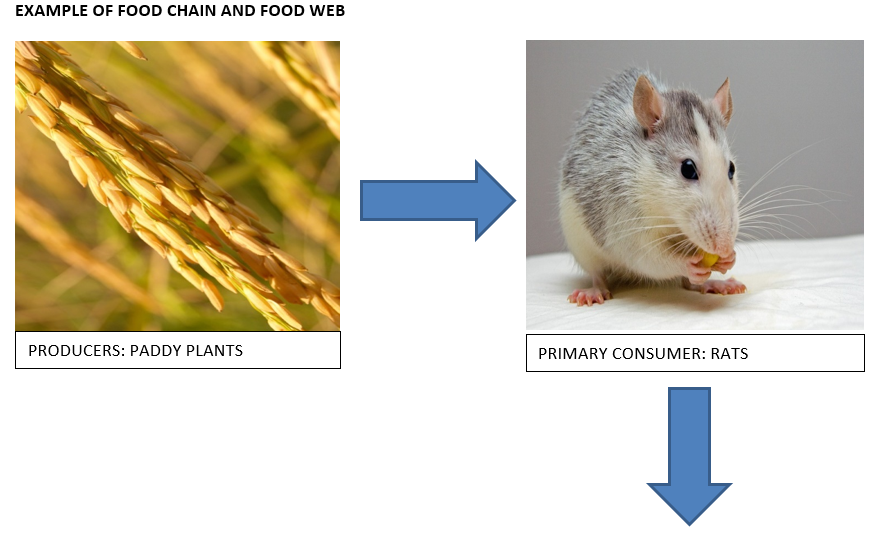

Source of image: https://pixabay.com/en/agriculture-asia-autumn-botany-1552392/
https://pixabay.com/en/rat-pets-eat-440987/
https://pixabay.com/en/snake-animals-reptile-non-toxic-501986/
https://pixabay.com/en/hawk-bird-prey-animal-nature-494064/
Example of food web

Source of image: //en.wikipedia.org/wiki/Food_chain#/media/File:Chesapeake_Waterbird_Food_Web.jpg


header.all-comments