LEVEL 1 (Standard 5 & 6 Primary School)
- Aug 9, 2016
- 5 min read
LESSON 1: Types of Microbes
Hi, guys! Have you ever wonder, why does your food still spoiled even though you seal it tightly to prevent from flies or cockroaches landing on your food? Does the air is causing the food to spoil or something that we cannot explain, like ghost or Boogeyman?
Actually, the air that we breath in not only contain oxygen and hydrogen molecules but also, they contain dust and millions of microorganisms! What are microorganisms? Microorganisms are a tiny creature that cannot be seen with our naked eyes and we can only see them by using a microscope.
Maybe some of you have heard about microorganisms before and some of you like to call them as “germs”. In Malaysia, people often called germ as “kuman” in Bahasa Malaysia. To be exact, in Microbiology world, we prefer to use the word microorganisms rather than “germs” because microorganisms clearly define as tiny organisms that mainly consists of bacteria, fungi, protists, virus and archaea. Below are the microscopic images of microorganisms:
Bacteria

source of image : https://pixabay.com/en/koli-bacteria-escherichia-coli-123081/
Fungi

source of image : Dr. Wan Zuhainis Saad, UPM Department of Microbiology
Protista

source of image : Siti Farhana Bajunid, UPM
Virus


source of image : Siti Farhana Bajunid, UPM
Archaea

source of image : https://commons.wikimedia.org/wiki/File:Halobacteria.jpg
LESSON 2: Bacterial Shapes
Did you know what bacterium is? The bacterium is a one-celled living organism that lives in the various part of the Earth from the deep soil, deep sea, volcano and even present on your skin! They are everywhere around you and you could never hide from them.
Not all bacteria are bad. There are also good bacteria that help you to fight the bad bacteria and make sure you stay healthy. We should be thankful to them!
Now let see what shapes do bacteria usually have when observing them under light microscope.
Bacteria have variety shapes and sizes. Their shapes consist of spherical, rod-shaped, spiral and even other shapes such as star or irregular shapes. Why these shapes are important to know?
Microbiologist need to identify these shapes so that they can classify these microbes into groups or arrangements. The first step after taking samples is we need to identify these microbial shapes so that we can classify them into groups. Such microbial physical characteristics are called as bacterial morphology. Let’s take a look at it, shall we?
1.Spherical - Spherical or also known as cocci exist as oval or elongated depending on how the cell is divided. There are a few characteristics for cocci shaped such as:

2. Rod-shaped - Rod-shaped or also known as bacilli. There are a few characteristics for bacilli shaped such as:

3. Spiral - There are a few characteristics for spiral shaped such as:

Source of image: http://www.public-domain-image.com/free-images/science/microscopy-images/escherichia-coli/e-coli-o157-h7-infection-often-causes-severe-bloody-diarrhea-and-abdominal-cramps/attachment/e-coli-o157-h7-infection-often-causes-severe-bloody-diarrhea-and-abdominal-cramps
4. Other shapes - There a few shapes of bacteria such as star shaped and irregular shapes. Did you know there are bacteria that are able to alter into other irregular shape or size in response to the changes in environment? This ability is call pleomorphism.
LESSON 3: Fungi
In this lesson, we will learn about fungi but before that let’s ask yourself, what is fungus? The fungus is either unicellular or multicellular organism that can be found in moist habitat, especially in soil. They are known as natural decomposers because they are able to decompose dead plants and animals to get nutrient from them.
Have you ever tried mushroom soup? It is very tasty especially when you eat it with garlic bread! But did you know that mushrooms are classified as fungi? Moreover, the bread that you eat also is made by fungus named yeast and when your bread has expired, they are spoiled by fungi called bread mold.
So what exactly fungus is? Fungus can be differentiated into three types which are:
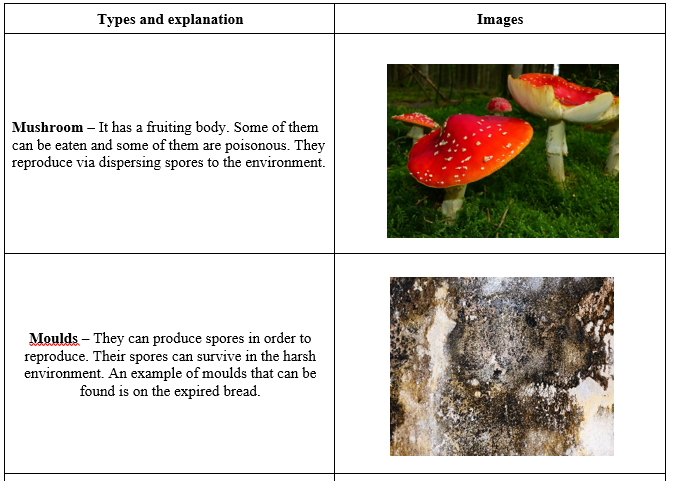

Source of image: https://commons.wikimedia.org/wiki/File:S_cerevisiae_under_DIC_microscopy.jpg
LESSON 4: Protista
Protists are unique creature since it shows characteristics of animal, plant or even fungus but since they lack something, they cannot be categorized into animal, plant or fungus.
They may lack of vascular system or organ just like animal.
Protist can be differentiated into:


Source of image: https://commons.wikimedia.org/wiki/File:PSM_V79_D576_Division_of_the_fertilization_nucleus_of_the_protozoa.pn
LESSON 5: Virus
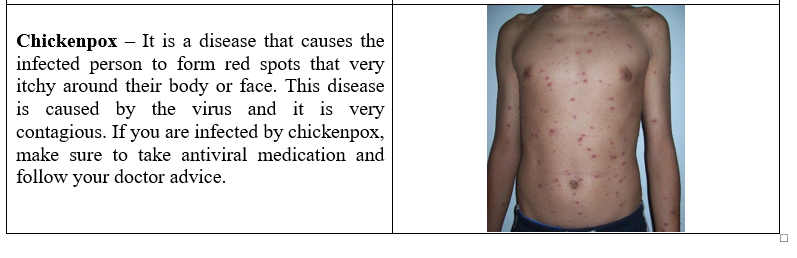
Have you heard about the virus? As a person who loves to play computer games or surfing the Internet, you understand the concept when the virus in the computer that causes your computer to hang, screen disappear, your computer is not responding to command and all you need is an antivirus to save your terminally ill computer! Same goes to the real life virus which causes other organisms to fall sick and even worse, they can cause death. Not like computer, it can be repaired with antivirus software to remove the virus but in real life, there are not many antiviral drugs discovered by scientist to treat infected organism.
A virus is a very tiny creature, which is smaller than the size of bacteria and require specific host in order to replicate. The virus is an acellular non-living organism since it cannot live on their own and require host to be alive.
However, virus from other organism cannot infect other species of organism for example virus from a dog cannot infect human unless the virus undergoes a mutation that can make them susceptible to human. This is due to their structure that allow them to bind to a specific host.
Every virus has protective protein shell of various shapes such as:

Source of image: https://commons.wikimedia.org/wiki/File:Marburg_virus.jpg
LESSON 6: Archaea
Archaea are prokaryotic organism that live in the extreme environments such as high temperature and acidic condition. It is believed that archaea are the earliest organisms that exist in the Earth before any other organism.
They can be differentiated into:


LESSON 7: Good Microbes VS Bad Microbes
We have learnt basic things about microorganisms so now let’s learn about the advantages and disadvantages of microorganisms. As I already stated in our previous lesson, not all microorganisms are bad and we still need them in our life.
So, let’s learn about good microorganisms!
Good microorganism is a useful organism and also gives benefits to other organisms such animal and plant. They also play important roles in the environment such as carbon cycle to make sure that our atmosphere always in optimum condition. They also give advantages for the food industries to make tasty food such as wine-brew, soy sauce and vitamins. They make our life become easier and even healthier by protecting us from harmful microbes.


Now, let’s move to bad microorganisms!
Bad microorganisms usually give harmful effect to other organisms. They ruined your life especially when it is related to health issues.

LESSON 8: Bacterial Colony Morphology
In this last lesson, we will learn about the morphology of microorganisms on the agar plate after we incubate them overnight.
We can see the morphology of the colonies on the agar with our naked eyes. What are colonies? Colonies are the group of single cell of the microbes that clump together with each other. The result of the clumping will cause them easily to be seen.
We can observe them by looking above and at the side of the agar plate. In this observation, we can identify their size, shape and also their texture.
These are the bacterial morphology:


Below is the example of E.coli colonies culture on EMB agar:

Source of image: Green metallic sheen, Escherichia coli, EMB
http://www.freepik.com/index.php?goto=41&idd=365796&url=aHR0cDovL3d3dy5zeGMuaHUvcGhvdG8vMTAxODQ2NQ==
Can you try to describe the colonies on the agar above?
Answer:
Form: Circular
Margin: Entire


Comments